
Software engineering, automation & applied AI services
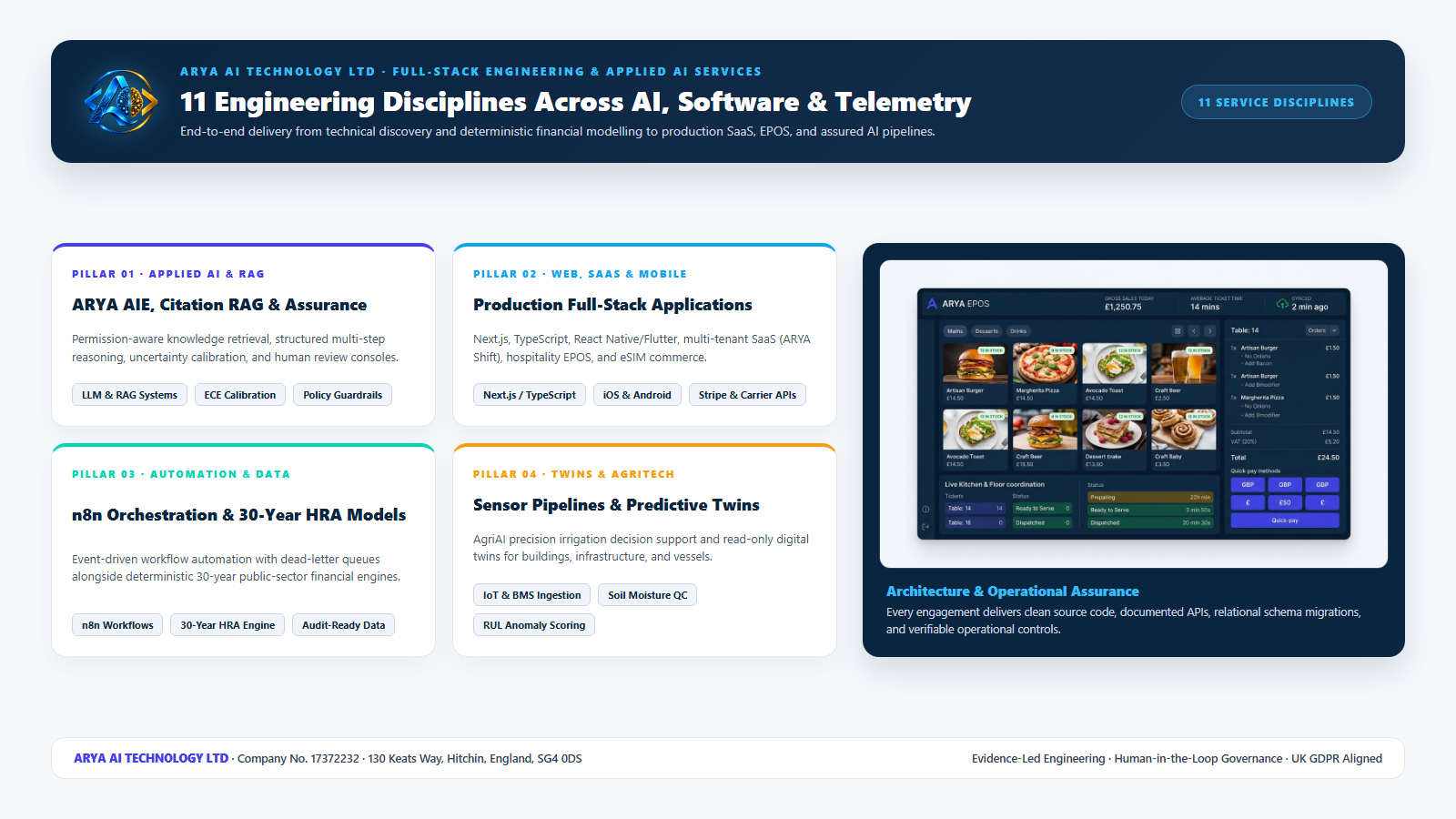
We structure our capabilities across 11 clear technical disciplines. For every category below, we explicitly separate services available today from capabilities under R&D development, and state realistic deliverables, delivery phases, and explicit scope exclusions.
1. AI & LLM Engineering
Available Today + Active R&D (ARYA AIE)Problem Addressed
Organisations want to adopt Large Language Models (LLMs), retrieval-augmented generation (RAG), and structured classification without uncalibrated hallucinations or loss of human oversight.
LLM API integration, permission-aware RAG prototypes with mandatory passage citations, schema-constrained JSON extraction, and human-in-the-loop review queues.
ARYA AIE REASON, LEARN, and TRUST multi-stage reasoning consistency checks and automated uncertainty calibration harnesses.
Typical Deliverables
- Documented RAG and LLM integration prototypes with passage-level source tracing
- Schema-validated extraction pipelines (Zod / Pydantic) with confidence scoring
- Human-in-the-loop review interfaces and explicit abstention fallbacks
Technologies Used
Standard Delivery Phases
Phase 1: Scope & Dataset Audit → Phase 2: Sandboxed Prototype → Phase 3: Evaluation & Handover
2. Custom Software & API Development
Available Today (Core Engineering)Problem Addressed
Growing teams outgrow fragile spreadsheets and disconnected SaaS tools, needing maintainable, strictly typed web platforms, mobile apps, and backend APIs.
Full-stack Next.js/TypeScript web platforms, RESTful and GraphQL APIs, PostgreSQL relational schemas, RBAC authentication, and cross-platform mobile apps.
Reusable sector-specific calculation modules (such as deterministic 30-year council HRA cashflow engines).
Typical Deliverables
- Production-grade full-stack web applications and administrative portals
- Documented REST APIs and Prisma/PostgreSQL database schemas with migrations
- Role-based access control (RBAC), session hardening, and audit logging
Technologies Used
Standard Delivery Phases
Phase 1: Architecture Spec → Phase 2: Iterative Sprints → Phase 3: CI/CD & Production Release
3. Business Process Automation
Available Today (n8n & Custom Webhooks)Problem Addressed
Skilled operations, finance, and support staff spend hours copying records between emails, CRM tools, spreadsheets, and accounting software.
Custom webhook orchestration, self-hosted or cloud n8n workflow design, automated document routing, and exception queues with manager sign-off.
Pre-packaged sector connectors for UK retail EPOS and agricultural compliance records.
Typical Deliverables
- Version-controlled n8n or custom TypeScript worker pipelines
- Dead-letter retry queues and automated failure alerting
- Human approval gates before external emails or accounting entries are posted
Technologies Used
Standard Delivery Phases
Phase 1: Process Mapping → Phase 2: Staging Automation → Phase 3: Live Monitoring
4. Data Engineering & Analytics
Available Today + Sector Analytics R&DProblem Addressed
Organisations hold valuable operational, financial, and telemetry data across siloed CSVs and databases without clean validation or scenario-modelling views.
PostgreSQL schema design, ETL/ELT ingestion pipelines, automated data-quality checks, and custom KPI/scenario dashboards.
Deterministic 30-year Housing Revenue Account (HRA 2027/28–2057/58) sensitivity sandboxes and agricultural water-balance analytics.
Typical Deliverables
- Validated relational and time-series database schemas
- Automated data cleaning, deduplication, and anomaly flagging scripts
- Interactive executive and operational dashboards with transparent SQL formulas
Technologies Used
Standard Delivery Phases
Phase 1: Schema & Quality Audit → Phase 2: Pipeline Build → Phase 3: Dashboard Validation
5. Digital Twins & IoT Telemetry
R&D Feasibility & Pilot EngineeringProblem Addressed
Infrastructure managers, building operators, and irrigated farms collect noisy sensor streams but lack calibrated tools to spot sensor drift or early equipment degradation.
Time-series ingestion schemas, sensor quality assurance checks (flatline/dropout detection), and read-only telemetry dashboards.
ARYA AgriAI smart irrigation field-trial workflows and regime-normalised anomaly detection for building HVAC and marine vessels.
Typical Deliverables
- Sensor telemetry quality audit and missing-data diagnostics
- Read-only shadow-mode digital twin state dashboards
- Split-plot or historical backtesting evaluation reports
Technologies Used
Standard Delivery Phases
Phase 1: Telemetry Audit → Phase 2: Shadow-Mode Ingestion → Phase 3: Pilot Evaluation
6. Cloud, DevOps & Self-Hosting Architecture
Available TodayProblem Addressed
SMEs and research projects require reproducible, cost-predictable cloud or self-hosted deployments with automated backups and environment isolation.
Docker containerisation, GitHub Actions CI/CD pipelines, Linux VPS / cloud deployment, Reverse Proxy (Nginx/Caddy) TLS hardening, and self-hosted PostgreSQL/n8n setups.
Automated sovereign-cloud deployment templates for UK public-sector and agricultural edge gateways.
Typical Deliverables
- Docker Compose / container deployment manifests and CI/CD workflows
- Staging and production environment separation with encrypted secrets management
- Automated database backup scripts and uptime health-check endpoints
Technologies Used
Standard Delivery Phases
Phase 1: Infrastructure Audit → Phase 2: Container & CI Setup → Phase 3: Runbook Handover
7. Cybersecurity Engineering & Application Hardening
Available Today (Secure Software Engineering)Problem Addressed
Web platforms and APIs face credential stuffing, injection flaws, broken access control, and supply-chain dependency vulnerabilities.
Application threat modelling, strict HTTP security headers (CSP, HSTS), rate-limiting, RBAC enforcement, Zod input validation, and RFC 9116 security.txt setup.
Automated security alert triage and dependency posture dashboards.
Typical Deliverables
- Application data-flow threat model and OWASP control review
- Hardened authentication, CSRF/XSS mitigation, and rate-limited API routes
- Dependency vulnerability audit and remediation PRs
Technologies Used
Standard Delivery Phases
Phase 1: Threat & Header Audit → Phase 2: Code Hardening → Phase 3: Verification Suite
8. Product Prototyping & MVPs
Available TodayProblem Addressed
Founders, innovation teams, and grant consortia need working, clickable, database-backed software prototypes to validate workflows with real users and assessors.
Rapid 4-to-8 week functional MVP engineering with clean UI design systems, real database persistence, and structured user feedback capture.
Pre-built domain starter kits for multi-vendor marketplaces and field-trial data collection.
Typical Deliverables
- Interactive, mobile-responsive web or mobile MVP deployed to a live staging URL
- Clean TypeScript/Next.js codebase with full source repository handover
- Architecture documentation ready for investor or grant assessor review
Technologies Used
Standard Delivery Phases
Phase 1: Wireframe & Schema → Phase 2: Core Build → Phase 3: Pilot User Testing
9. Research Collaboration & Feasibility Studies
Active R&D & Grant Consortium PartnerProblem Addressed
Universities, agricultural facilitators, and public bodies need an agile UK software SME partner to co-design technical work packages, build trial software, and run empirical evaluations.
Technical work-package scoping, synthetic benchmark engineering, field-trial data collection apps, and collaborative UKRI / Innovate UK / ADOPT bid preparation.
Joint evaluation publications across ARYA AIE, ARYA AgriAI, and Digital Twins.
Typical Deliverables
- Structured technical feasibility reports and system architecture specifications
- Experimental software harnesses and reproducible evaluation datasets
- Transparent milestone reporting aligned with UK public funding standards
Technologies Used
Standard Delivery Phases
Phase 1: Consortium Scoping → Phase 2: Feasibility / Alpha → Phase 3: Empirical Evaluation
10. AI Governance, Red-Teaming & Evaluation
Available Today + AIE TRUST ResearchProblem Addressed
Organisations deploying third-party or internal AI tools lack structured model cards, boundary tests, and UK GDPR-conscious human oversight protocols.
Internal AI system registers, Model & System Card authoring, prompt/schema boundary testing, and human-override audit log engineering.
Automated AIE TRUST runtime policy enforcement and calibration drift monitors.
Typical Deliverables
- System & Model Cards documenting intended scope, limitations, and prohibited uses
- Red-team and boundary-condition test suites verifying abstention behaviour
- Human-in-the-loop governance workflows aligned with UK DSIT principles
Technologies Used
Standard Delivery Phases
Phase 1: AI Risk Inventory → Phase 2: Boundary Testing → Phase 3: Governance Gate Setup
11. Legacy Integration & Spreadsheet Modernisation
Available TodayProblem Addressed
Critical financial models (such as council 30-year HRA plans) and operational rosters are often trapped in brittle multi-tab spreadsheets or legacy databases without audit trails.
Migrating complex Excel/CSV business logic into deterministic, version-controlled TypeScript/Python calculation engines with web dashboards and CSV/API import-export.
Automated formula-parity verification harnesses comparing legacy spreadsheet outputs against modernised web engines.
Typical Deliverables
- Deterministic web-based calculation and scenario-modelling engines
- Automated import/export adapters for CSV, Excel, and legacy REST/SOAP endpoints
- Complete assumption change logs and role-based approval workflows
Technologies Used
Standard Delivery Phases
Phase 1: Formula & Schema Audit → Phase 2: Parallel Engine Build → Phase 3: Parity Sign-Off